The era of audiences is ending. Here's what comes next.
For twenty years the web has worked backwards. We build one page for everyone and hope the right people find it. We sort visitors into segments and call that understanding. of1 builds the page for the person who is actually looking at it.

What if your website could listen
Picture a website that doesn't serve the same page to every visitor. Not a chatbot in the corner, and not a recommendation widget at the bottom. The page itself, with every headline, case study and call to action chosen for this person, right now.
The page your visitor sees isn't the page you published. It's the page they needed, and it arrives as if it had always been there.
This isn't science fiction. Three things changed at the same time.
Three breakthroughs. All at once.
Inference moved to the edge
route
- Visitor
- Edge node
- Data center
Models got fast enough to disappear
speed
page renders
- Now
- A year ago
AI learned to stay on-brand
brand
- voice
- design system
- guardrails
Written for this visitor “One perfect cup. Every morning.”
Your visitor doesn't know. That's the point.
The visitor arrives and the page makes sense to them. Not because they navigated perfectly, but because the page already took them into account. They do less work and get an answer to the question they actually have.
They don't feel targeted. They feel understood, and people can tell the difference right away.
If they look for the seams they can find them. The page doesn't hide what it is. It just doesn't advertise it.


Three stages. 2.5 seconds.
A generated page gets up to 2.5 seconds. Picking an approved image or fragment is much quicker, at 50 to 200 ms.
Understand
- searched for
- came from
- time of day
Reason
- headline
- section order
- case study
Compose
Two modes. One pipeline.
Explicit: the visitor asks.
They type a question or say what they want, and the page recomposes around it. It works like search, but instead of ten blue links they get a whole page.
They search
an espresso machine I can take camping
of1 writes the page

Arco Viaggio: portable, no electricity
Implicit: the site notices.
No typing. What they've done on the site, where they came from and the time of day shift the page quietly to meet them where they are.
The site reads the visit
- 4 pages
- 29 s dwell
- 75% scroll
of1 rewrites the hero

Precision Brewing, Perfect Water
- Understand
- Reason
- Compose
Both modes share the same pipeline. The only difference is who starts the conversation.
Five levels. Start with the one you trust.
You don't have to hand a model your whole site on day one. Each level lets it do a little more than the one before, and every level falls back to the page as published.
Default photo
Picked for a cyclist


Picks an image
Tag an image slot with a collection and of1 picks the closest match for the visitor from photos you've already approved. There's no LLM call, and nothing is written.
50–200 ms
Default promo
Seasonal promo picked


Picks a fragment
The same idea for a whole piece of content, like a promo, a testimonial or a pricing table. of1 chooses one of your approved fragments. Still nothing is written.
50–200 ms
As authored
Marked text rewritten
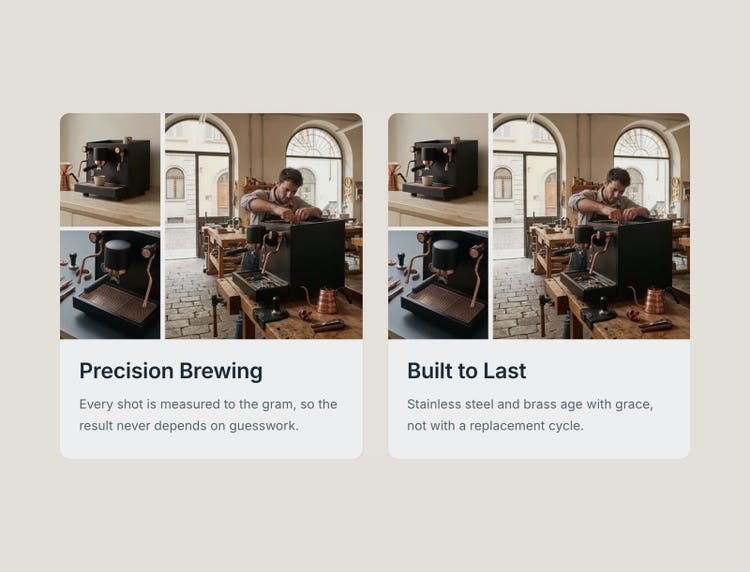

Writes where you mark
The model rewrites only the text you mark: one block, one sentence, or the tags a section allows. Structure, images and layout stay as authored.
up to 2.5 s
Published headline
Headline rewritten

Rewrites the headline
With no markup at all, of1 reads the visitor and adjusts a few key lines, such as the headline, the subhead and the call to action, inside a 2.5-second budget.
up to 2.5 s
A question
A whole page
best models for cyclists

Writes the whole page
A visitor asks a question and of1 assembles a page from your block library, filled from your products, FAQs and pages. It never writes HTML or CSS.
up to 2.5 s
Most teams start at level 1 or 2 on a single page, then move up once they've seen what the model does. The documentation shows how each level is authored.
One button. Your entire site.
It isn't a widget you embed or an engine bolted onto the side. of1 works across your whole site, on every page and in every section. Turn it on and every visitor's experience improves.
No rules to write, no segments to define, no content matrix to maintain. The content is already on your site. of1 decides which parts of it matter most to each person.
arco.coffee
hero

arco.coffee
table
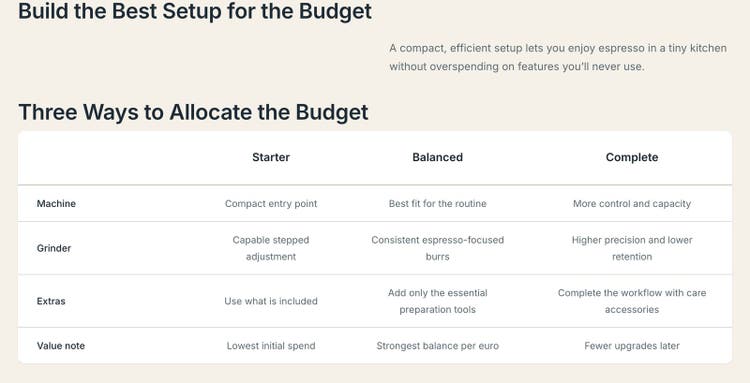
arco.coffee
carousel
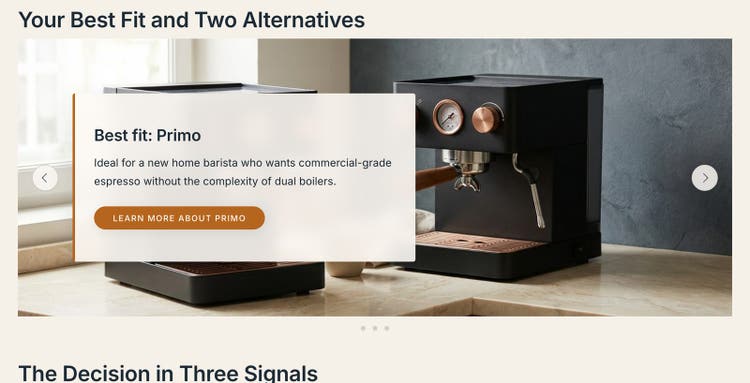
2.5 seconds. Or it doesn't ship.
Speed isn't a feature of of1. It's the constraint that shapes everything else. If a generated page takes longer than 2.5 seconds, the visitor notices, and then the technology is in the way.
2.5 seconds is the ceiling for generation, not the time every page takes. Selective levels pick an approved image or fragment in 50 to 200 ms.
Edge inference, aggressive caching and progressive rendering do the hard engineering so the experience feels effortless.
of1 runs on Adobe Edge Delivery Services, Adobe's edge-native web platform. Every of1 site needs it, because it provides the block-based content model and the edge delivery the pipeline is built on.
The web was never meant to be one-size-fits-all.
of1 is in early access. We're working with a small number of brands who believe their visitors deserve better than segments.